The Interesting Life of B.J. Casey
By: Dr. Jess McCullough, Museum Director
Falling down an unexpected rabbit hole is easily one of the great pleasures of historical research, as I experienced earlier this month while mining the archives for information on the Pattison Family’s domestic staff.
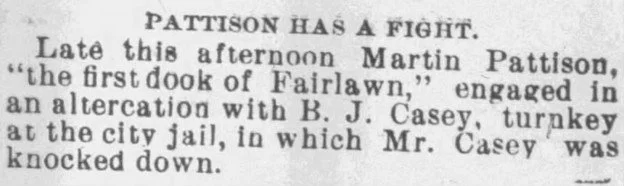
The Evening Telegram, April 4, 1893
As was normal for newspapers of this time, this was the entirety of the story. The exact cause of the altercation will forever be lost to us, but it did prompt many questions in me. Who was B.J.Casey? Why was he ‘altercating’ with the 52-year-old former Mayor of Superior? My research immediately turned to Mr. Casey, and I was in for a ride.
Bernard James Casey was bornin 1840 in Ireland and emigrated to the United States in 1857, relocating with his family after the Civil War to Western Wisconsin where they farmed in Prescott and later Trimbelle before arriving in Superior around 1886. While not included in the usual list of Superior’s titans of industry and government, Casey was active in Superior politics during its boom years. While Martin Pattison was a committed Republican, Casey appears to have been a populist, active in the Union Labor Party and eventually the Democratic Party. In 1896, Casey argued so passionately for the “Free Silver” issue that the Telegram ran a cartoon suggesting a Vaudevillian Gold vs. Silver debate for the entertainment of the city.
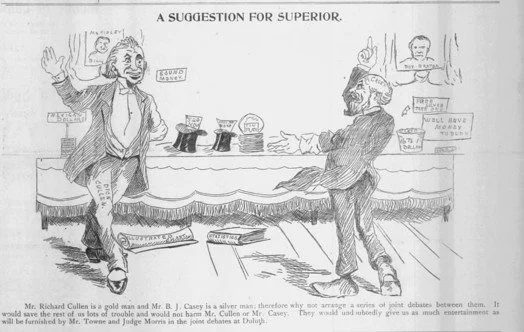
The Evening Telegram, August 13, 1896
Casey was not only a political gadfly, but a longtime municipal employee. At the time of his row with Pattison, Casey was employed as the jailer in the City Hall building. He appears to have been removed from the position shortly thereafter - not for fighting with the former mayor, but for alleged cruelty to a prisoner. Casey wasn’t out of City Hall for long, however. Mayor Kennedy appointed him the janitor of the building that fall.
The public story of B.J. Casey only gets more strange. In the summer of 1894, the Barnum & Bailey Circus visited Superior. Casey, a father of sixteen children (which included an entire baseball team: the Casey 9), used his jailer’s badge to get them in to see the elephant. Rookie cop Gust Erickson (appointed by Mayor Martin Pattison, no less) arrested Casey for impersonating a police officer. Not one to back down from a fight, Casey sued Erickson for false arrest. For the next two years, both Casey and Erickson spent time in jail over the affair, before reaching a settlement in December of 1896.
Casey relocated to Seattle in 1906 and passed away there in 1915, but his legacy in Superior was such that the Telegram prominently ran his obituary.
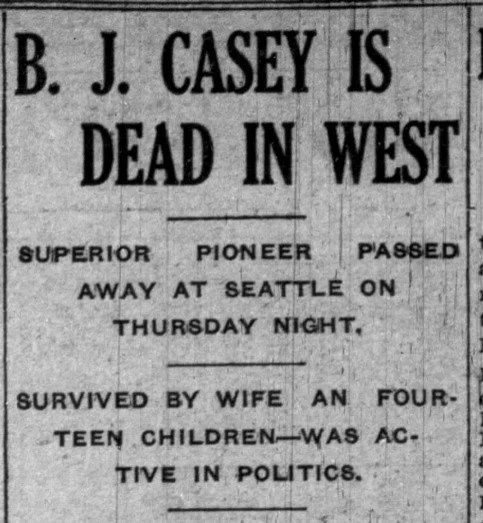
The Evening Telegram, September 11, 1915
Casey’s story is a fascinating counterpoint to that of Martin Pattison’s. Pattison was a millionaire, a tycoon of industry, a three-time mayor, a philanthropist, and he had the means to establish an official legacy as the City Father in Superior. Casey was a farmer, a jailer, a janitor, and a firebrand, and yet he, too, certainly made his mark. The intersection of Casey’s story with that of a man like Martin Pattison adds color to the tapestry that was 1890s Superior, and makes it a bit more real, to me anyway.
Oh, and I have one last fun fact about B.J. Casey for you:
One of his sixteen kids, former Superiorite Bernard Francis Casey, was beatified in 2017 by Pope Francis in front of tens of thousands in Detroit. You may know him as Blessed Solanus Casey.
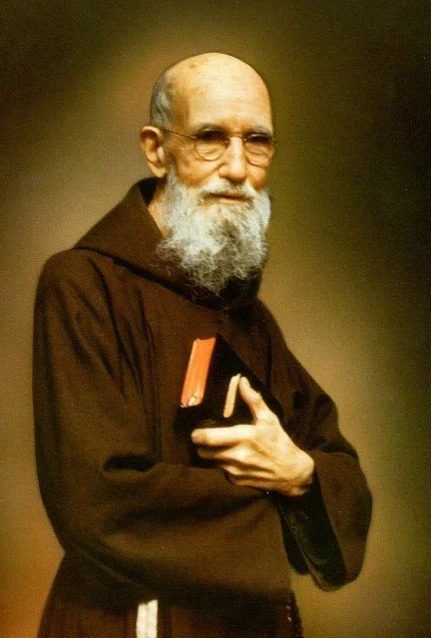
By User:Mahatma Gandhi - Own work, CC BY-SA 3.0, https://commons.wikimedia.org/w/index.php?curid=28701177